The Problem That Started It All
In the fall of 2023, we spent hours walking through strawberry fields at Punjab Farms in Bonham, Texas. The farm's owner, Harman, showed us row after row of plastic mulch beds, explaining the challenges of monitoring thousands of individual plants. "By the time we notice a problem and walk out here to check it," he said, "it's often too late for that section of plants."
That conversation planted the seed for Chowkidaar. We realized that small and midsize strawberry farms needed a way to monitor their crops continuously without requiring farmers to physically walk every row multiple times a day. But building an agricultural robot from scratch? That seemed impossible for a small team.
Starting With What We Had
We didn't have a fancy lab or millions in funding. What we had was a garage, some Arduino boards, and a burning desire to solve this problem. Our first prototype—affectionately called "Gharooka v0.1"—was built on a wooden platform we bought from Home Depot.
The initial design was simple: four wheels, basic motors, a Raspberry Pi for the "brain," and enough sensors to avoid running into things. We literally held some parts together with duct tape and zip ties. But you know what? It worked.
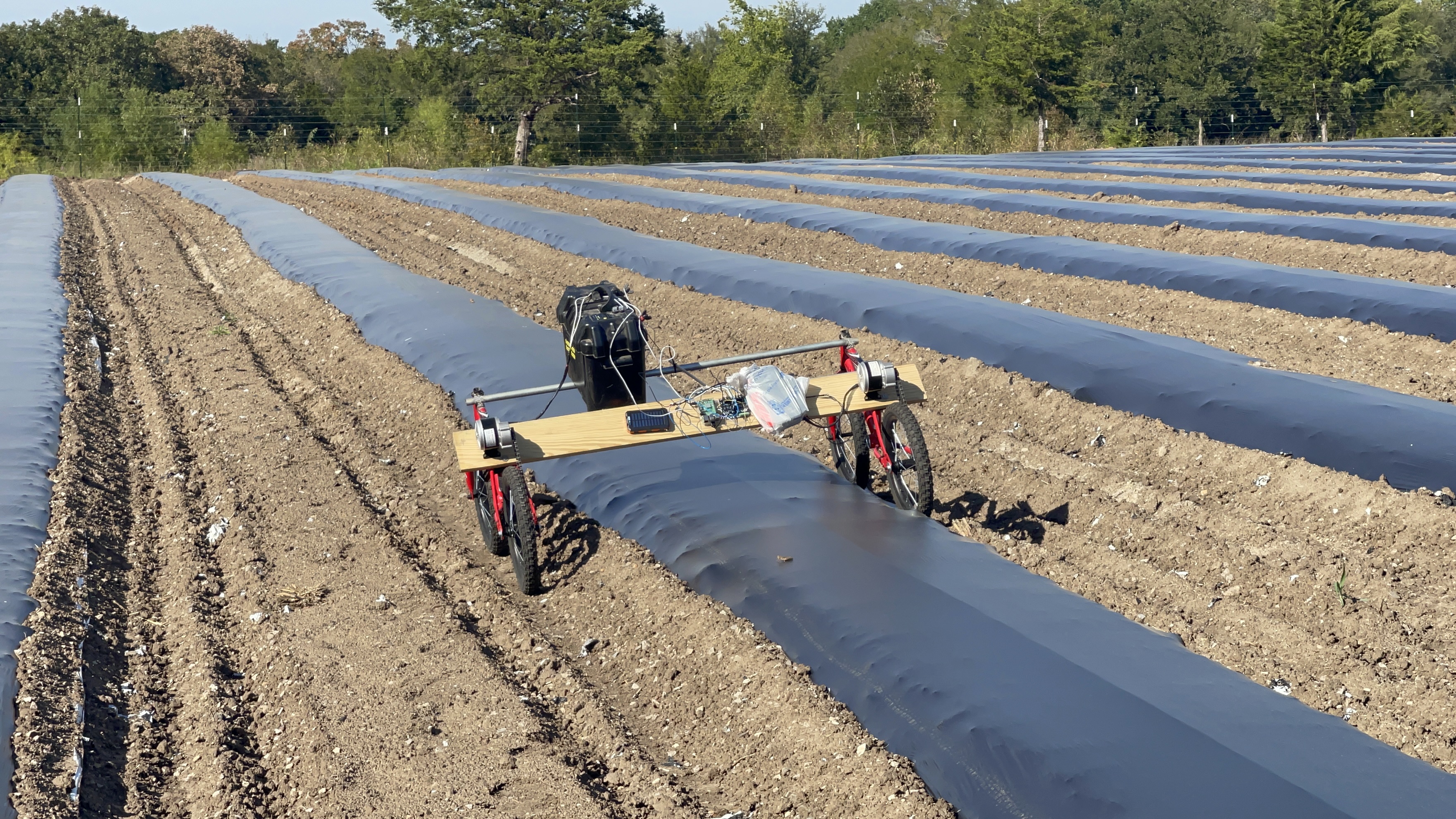
Our first prototype navigating the plastic mulch at Punjab Farms—wood, wheels, wires, and a lot of hope
The First Test Run
The morning of our first field test, we were equal parts excited and terrified. We had tested the robot in our garage and on flat pavement, but a real strawberry field with plastic mulch, uneven terrain, and actual plants? That was different.
We placed Gharooka v0.1 between two rows of plastic mulch beds and hit start. It lurched forward, wobbled a bit, then found its path. As it rolled down the row, cameras capturing images and sensors collecting data, we literally held our breath. When it reached the end of the 100-foot row and stopped without incident, we erupted in cheers.
It wasn't perfect—far from it. The robot was slow, the data collection was basic, and we had to manually retrieve it and move it to the next row. But it proved the concept: an autonomous robot could navigate farm beds and collect plant data.
Learning From Failure
Of course, not everything went smoothly. During our second week of testing, the robot got stuck in soft soil after a rain. Another time, a connection came loose and it started spinning in circles. Once, a wheel fell off mid-run. We joke now that we learned more from our failures than our successes.
Each failure taught us something valuable:
- Weather matters: We added weather-resistant enclosures for the electronics
- Power is critical: We upgraded from small batteries to a larger solar-powered system
- Navigation needs precision: We improved our GPS and added better wheel encoders
- Data quality trumps quantity: We focused our cameras and refined our image processing
- The real field is unpredictable: We built in redundancy and failsafes for unexpected conditions
The Breakthrough Moment
About two months into testing, we had a breakthrough. We had been collecting plant images daily, and our machine learning model was getting better at identifying healthy versus unhealthy plants. One morning, our system flagged a small section in row 15B with unusual patterns.
When Harman walked out to check it, he found early signs of spider mites—something that would have spread throughout that section if caught even a few days later. He was able to treat just those few plants and prevent a much larger problem. That's when we knew we were building something that could make a real difference.
From Prototype to Product
That first prototype taught us countless lessons that shaped Chowkidaar as it exists today. We moved from wood to weatherproof composite materials. We upgraded from basic cameras to advanced computer vision systems. We replaced zip ties with proper engineering. But the core concept—an autonomous robot that knows each plant individually—remained the same.
Today's ScoutBot is leagues ahead of that first duct-taped prototype, but we keep a photo of Gharooka v0.1 in our office as a reminder. It reminds us that every sophisticated technology starts with a simple idea and the courage to build something, even if it's held together with duct tape.
What We Learned About AgTech Development
Building agricultural technology is different from building consumer tech. Here are the key lessons from our prototype phase:
Key Takeaways:
- Test in real conditions early: A lab can't replicate mud, heat, rain, and unpredictable terrain
- Partner with actual farmers: Their feedback is more valuable than any engineering theory
- Build for durability: Farm equipment takes a beating—your tech needs to handle it
- Start simple, iterate fast: Get something working, learn from it, improve it
- Focus on the problem, not the technology: Farmers care about results, not impressive specs
Looking Forward
Today, Chowkidaar can do things that seemed impossible when we built that first prototype. It can chart planting layouts, burn holes in plastic mulch, track thousands of individual plants, detect diseases before they're visible to the human eye, and even assist with harvesting.
But we're still in the early days of agricultural robotics. Every farm we work with teaches us something new. Every growing season brings new challenges and opportunities for improvement.
If you're thinking about building something in AgTech, our advice is simple: start. Build a prototype—even if it's held together with duct tape. Test it in real conditions. Learn from farmers. Iterate. The future of farming won't be built in laboratories alone; it'll be built in fields, one prototype at a time.
Want to See the Latest Version?
We've come a long way from that first prototype. Schedule a demo to see how far Chowkidaar has evolved and how it can help your strawberry farm.
Request a DemoAbout the Author: This post was written by the Chowkidaar founding team, who spent countless hours in strawberry fields turning an idea into reality. We believe in sharing our journey openly to help others building AgTech solutions.